


TFA (trifluoroacetic acid) is a water-soluble, highly mobile chemical that cannot be broken down naturally. It enters groundwater and drinking water, for example, through the use of plant protection products. It is often referred to as a ‘forever chemical’ and cannot be removed using conventional water treatment methods.
Blog
It is not just microplastics that end up in our tap water and food: plastic contains up to 16,000 chemicals, 4,200 of which are classified as harmful to humans and the environment.
See: https://www.srf.ch/radio-srf-1/neue-studie-plastik-als-risiko-tausende-chemikalien-und-kaum-kontrolle
What can we do?
AVOID PLASTIC PACKAGING FOR FOOD AND DRINKS AS MUCH AS POSSIBLE:
Remember that Tetra Paks, tins and some ‘paper packaging’ for fruit and vegetables are lined with plastic.
AT LEAST REMOVE MICROPLASTICS FROM OUR TAP WATER:
e.g. with a SAN-MINI Kombi and its unique titanium filter cartridge with a 0.2-micron filter rating, which filters out not only the majority of microplastics but also other undissolved substances such as heavy metals and PFAS. The activated carbon filter also removes chemicals.
All this without electricity, without plastic, without rubber, without glue, and without complicated installation.
SAN-MINI and SAN-MAXI are the only products in the world that do not use plastic and have been awarded the Global Award and the Prestige Award.
I’m not going to filter out something that I’ll then have to pay to consume again.
As a specialist in social and preventive medicine, I can fully understand this line of thinking.
The most important minerals found in tap water are probably magnesium and calcium.
So let’s take a look at how much of these two minerals is contained in drinking water (the values may vary from municipality to municipality):
Magnesium: 4–30 mg/l (examples: Arosa and Recherswil) => approx. 20 mg/l
Calcium: 8–120 mg/l (examples: Arosa and Risch) => approx. 65 mg/l
Let’s now put this into perspective with the recommended daily intake for an adult:
Magnesium: 300–400 mg/day => Ø 350 mg/l
Calcium: 1000–1200 mg/day => Ø 1100 mg/l
It follows that we need the following amounts of tap water per day to meet an adult’s daily requirement:
Magnesium: 350 mg / 20 mg/l = 17 litres of tap water
Calcium: 1100 mg / 65 mg/l = 17 litres of tap water
Enjoy drinking 17 litres of tap water a day...
Whether you drink tap water or not, you must make sure you get enough magnesium and calcium from other sources. Here are a few recommendations:
Magnesium: Oatmeal (130 mg/100 g), Brazil nuts (360 mg/100 g), hemp seeds (650 mg/100 g), soya beans (220 mg/100 g) and cocoa (480 mg/100 g)
Calcium: hard cheese (1000 mg/100 g), yoghurt (130 mg/100 g), kale (200 mg/100 g), broccoli (200 mg/100 g), almonds (260 mg/100 g)
Tip:
You’re thoughtlessly throwing away the purest and most concentrated source of calcium and collagen.
These are eggshells, or rather eggshell membranes.
Why not collect your eggshells along with the membranes, boil them and dry them in the oven at <120°C.
Then grind them in a mortar or grinder and add the powder to your salt, your spices or your muesli. Just 1.5g of this is enough to meet your daily requirement.
Conclusion:
There are more efficient and purer sources for meeting your daily mineral requirements than tap water.
That is why I recommend – especially for children and the elderly – filtering tap water to remove the substances it contains, so that you do not ingest nitrates, nitrites, heavy metals, medicines, hormones, PFAS, microplastics, etc.
I have developed a number of devices for this purpose, which you can install discreetly in your kitchen plinth so that you can conveniently drink purified water straight from the kitchen tap.
An automated solar cover with solar slats offers many advantages:
- UV light does not enter the pool by inhibiting the formation of algae.
- The solar slats are easy to clean.
- Opening and closing the pool is effortless and requires no force.
- The pool water is heated slightly while the temperature is maintained at nighttime.
However, there are also disadvantages to using solar slats:
Solar slats only heat the uppermost, already warmest layer of water. This water reaches deeper layers via the skimmer or overflow, but only when the filtration pump runs. To do this, it has to pass through the entire pipework, the pump and the water filter, which causes it to give off heat.
It would be more efficient to heat the deeper layers of water directly and let it flow back down again - which is what absorber technology does.
Another disadvantage of solar slats becomes apparent when the water reaches the ideal pool temperature: you cannot stop the heating cannot unless you open the pool. Unfortunately, it's not always possible: during the summer vacations, for example.
Very warm water favourites the formation of algae and bacteria and therefore requires more chemicals.
The advantages of absorber technology for pool heating:
Absorber technology works on a temperature-controlled basis: The system measures the water temperature and the temperature of the absorbers in the sun. With a sufficient temperature difference, a small pump switches on and feeds the pool water through the absorbers. On a sunny day, a pool with a volume of 40m³ and an absorber surface area of 25m² can be heated by up to 6°C. If the pool is too warm, you can run the pump manually at night to cool the water down efficiently.
Our recommendation for optimum pool heating:
To efficiently heat your pool, combine somple slats that maintain the temperature at night with absorber technology. This way, you can always enjoy the optimum water temperature with the lowest heating costs.
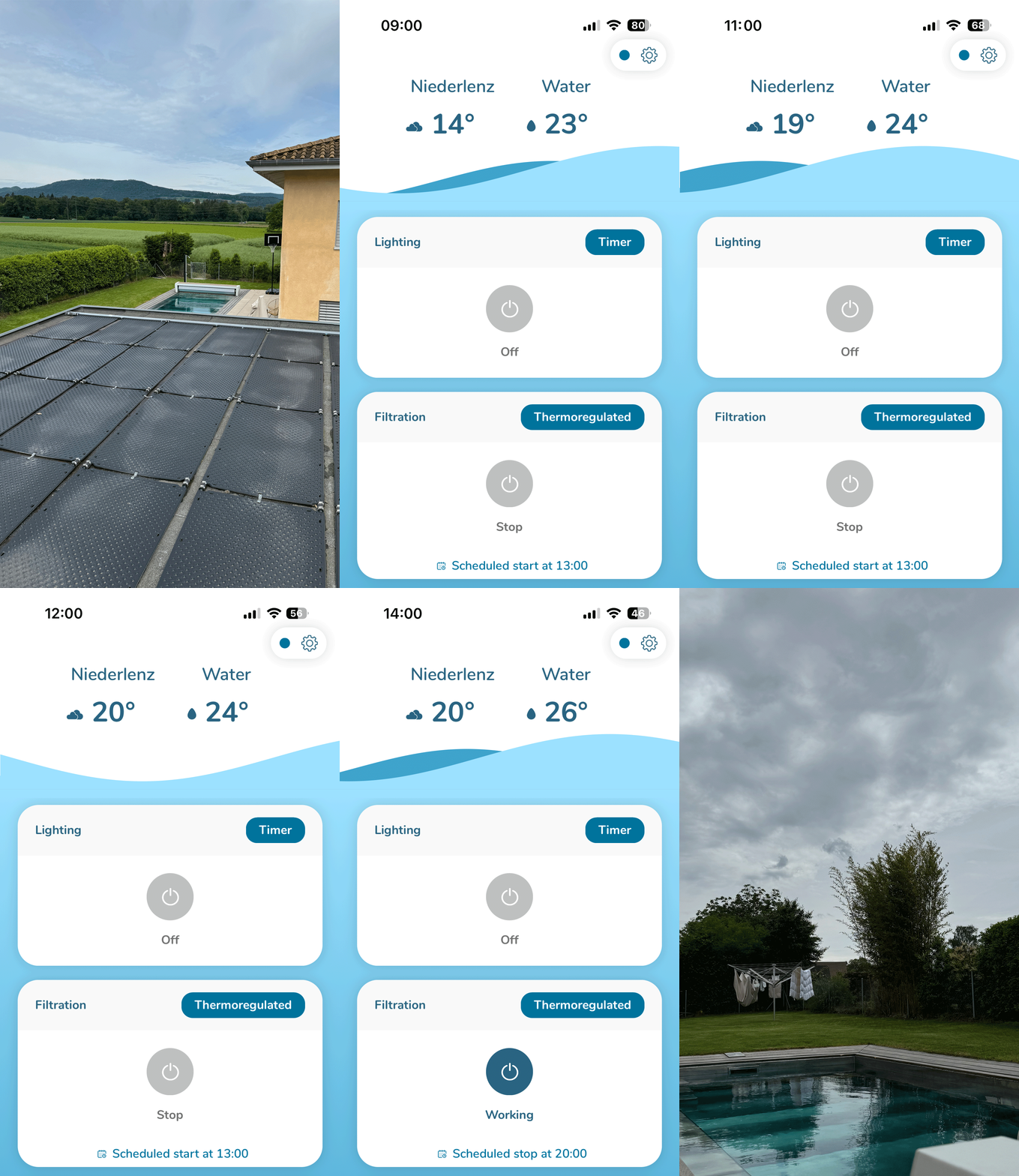
The example picture shows the temperature development in a pool with absorber heating and slatted cover on a cloudy day at max. 20°C. The pool is constantly at least 4°C warmer than the ambient temperature and cools down much less at night.